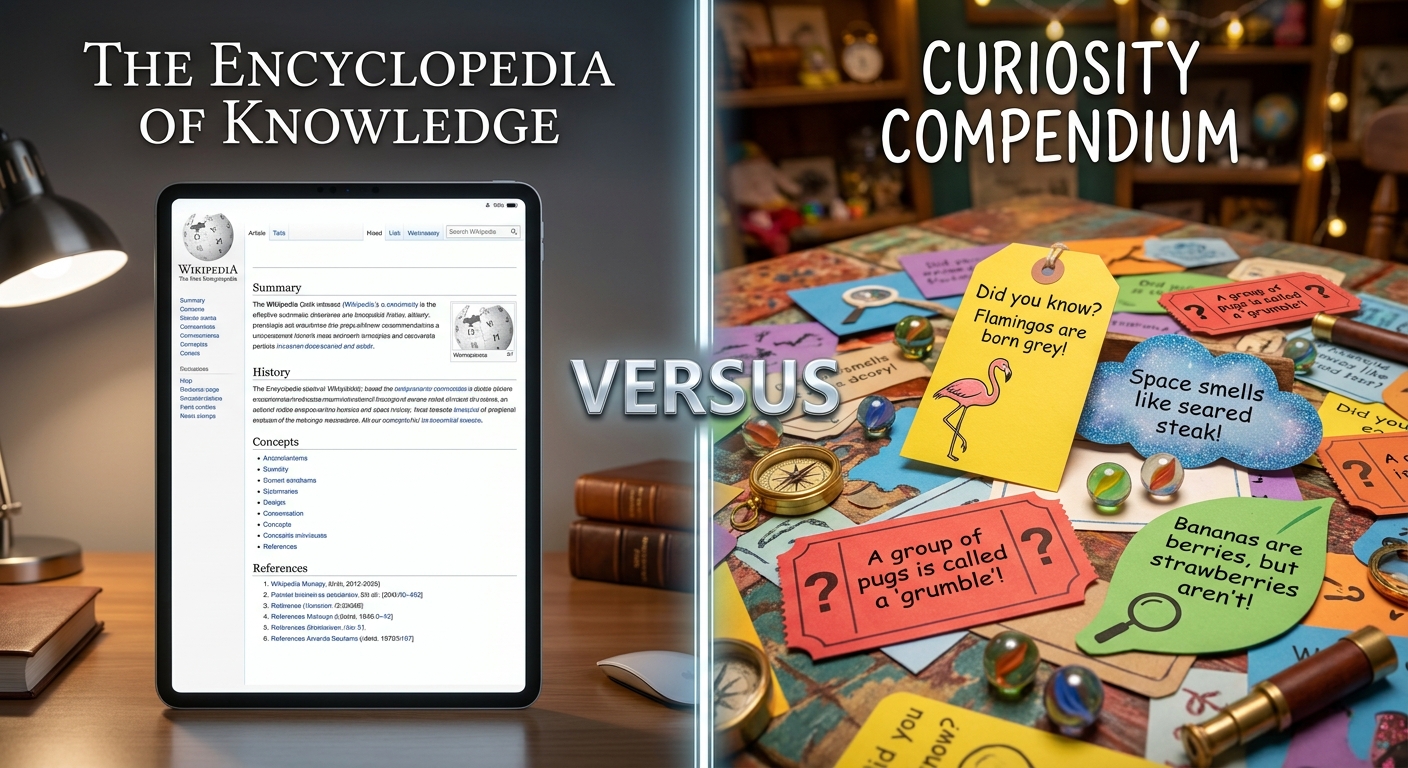
Wakkipedia vs. Wikipedia: Serious Encyclopedia or Curiosity Compendium?
In our information-rich era, online encyclopedias serve diverse needs. Wikipedia stands as a cornerstone for structured knowledge, while platforms like Wakkipedia, an "online encyclopaedia of interesting but useless information, trivia, and facts" created by William Hartston, offer a different kind of intellectual engagement. This analysis explores their distinct editorial approaches, information hierarchies, reliability standards, and their specific uses and limitations for knowledge consumption.
Foundational Philosophies and Editorial Approaches
The core difference between Wikipedia and Wakkipedia lies in their fundamental purpose and guiding principles.
Wikipedia: The Pursuit of Verifiable Knowledge
Wikipedia aims to compile the sum of all human knowledge, driven by principles of Neutral Point of View, verifiability, and the use of reliable sources. Its content is community-sourced and rigorously refined by editors focused on accuracy, comprehensiveness, and objective presentation, making it a primary reference for general and academic inquiry. Articles are designed for depth, context, and precision.
Wakkipedia: Embracing the Intriguing and the Unconventional
Wakkipedia, conversely, thrives on delightful irrelevance. Its philosophy prioritizes engaging, often quirky facts and trivia that, while not always practically applicable, are inherently interesting. William Hartston's vision is to entertain and spark curiosity, not to educate in a traditional sense. The editorial focus is on the amusing, the absurd, and the fascinatingly obscure, prioritizing a "wow" factor over exhaustive academic rigor.
Information Hierarchy and Structure
Their differing philosophies lead to distinct organizational structures and user experiences.
Navigating Wikipedia's Rigorous Architecture
Wikipedia features a highly structured, hierarchical architecture. Topics are meticulously categorized and cross-referenced with extensive internal linking, often breaking down into numerous sub-articles for detailed exploration. Users typically navigate with specific queries, expecting comprehensive articles that offer deep dives into specialized knowledge areas.
Wakkipedia's Tapestry of Tidbits
Wakkipedia's structure is more a compendium of anecdotes. While categories exist, the emphasis is less on logical knowledge progression and more on serendipitous discovery. Users might stumble upon entries about trivial but intriguing facts, intended as standalone nuggets to be enjoyed as quick, engaging reads rather than parts of a larger knowledge framework.
The Crucial Question of Reliability and Verifiability
The platforms diverge significantly on standards of reliability and verifiability.
Wikipedia's Strengths and Struggles with Accuracy
Wikipedia demands that every claim be backed by reliable, published sources. Despite challenges like vandalism, its robust community self-correction mechanisms, including strict notability and dispute resolution, generally ensure a high level of accuracy. However, it's advised to use Wikipedia as a secondary source, requiring verification with primary materials for academic work.
Wakkipedia's Different Standard of Truth
Wakkipedia operates with different assumptions regarding "truth." While facts are generally intended to be accurate, it doesn't demand the same rigorous external verification as Wikipedia. The platform's charm often lies in the novelty or mild absurdity of the fact itself. Occasional unverifiable or slightly exaggerated facts might even enhance its appeal, reinforcing its role as a curiosity compendium rather than a strictly academic resource.
Distinct Uses and Limitations
Understanding these differences is crucial for appreciating each platform's unique value.
Wikipedia: The Go-To for Academic and General Inquiry
Wikipedia is an unparalleled resource for initial research, fact-checking, and gaining broad understanding across almost any topic. It serves students, journalists, and anyone seeking comprehensive, well-structured information. Its limitations include potential for subtle biases, the need to cross-reference with primary sources, and the sheer volume of data, which can sometimes be overwhelming.
Wakkipedia: A Haven for Curiosity and Entertainment
Wakkipedia excels as a source of light entertainment, a stimulator of tangential thought, and a generator of interesting anecdotes. It’s perfect for quick mental breaks, finding conversation starters, or indulging momentary curiosity. Its limitations are clear: it is unsuitable for academic research, critical decision-making, or building systematic subject understanding. Treating its content as rigorously verified truth would be a misapplication of its purpose.
Conclusion
Wakkipedia and Wikipedia, though both online encyclopedias, serve fundamentally different facets of human knowledge consumption. Wikipedia stands as a monumental testament to collective human intellect, meticulously cataloging information for serious inquiry and education. Wakkipedia, conversely, champions the joy of discovery for discovery's sake, celebrating the quirky, the amusing, and the delightfully trivial. Neither is inherently "better"; rather, they are complementary, each enriching our digital landscape by fulfilling distinct intellectual and recreational needs. The choice between them depends entirely on whether you seek foundational knowledge or a fleeting moment of intriguing insight.